Monday, April 12, 2010

Jazz Appreciation Month: Guitar

cover of Jazz Icons DVD: Wes Montgomery 1965 The earliest jazz ensembles used the banjo and piano for making chords but with the development of electrification, the guitar replaced it in post-War jazz. Inventor-craftsmen with now-famous names like Gibson, Fender, Les Paul and Rickenbacker turned the soft-sounding instrument into one capable of holding its own against trumpets, saxophones, pianos, and drums. The Smithsonian owns many innovative guitars, and has posted pictures of some important and interesting guitars here. For books on developments in guitar-making, use the subject keyword search guitar and history.

Wes Montgomery (left) was an Indianapolis native who lived from 1923-1968. His idol was Charlie Christian, and he is credited with influencing many of today's guitar players, so he is indeed a "central" figure in guitar history. Critics and afficianados alike consistently place him near the top in lists of the greatest jazz guitarists of all time. Between stints in touring ensembles, he played in many of the Indianapolis jazz clubs of his day while also working first shift in a local factory. He died in his hometown, from a heart attack, at age 44, and is buried in New Crown Cemetery. Indianapolis named Wes Montgomery Park in his honor.

Famous early guitarists:
Les Paul
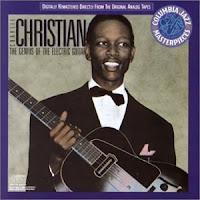
Charlie Christian (right)
Django Reinhardt


Cover of Charlie Christian CD

Guitarists of the 1950s-1960s:
Wes Montgomery
Kenny Burrell (right)
Herb Ellis
Charlie Byrd
Tal Farlow
Bucky Pizzarelli

photo of Kenny Burrell playing guitar

Modern stars of jazz guitar include:
Pat Metheny (right)
George Benson
Al DiMeola
Lee Ritenour

picture of Pat Metheny playing guitar

Friday, April 9, 2010

Jazz Appreciation Month: Jazz DVDs

photo of Great Day in Harlem
The Educational Resources Collection on the Lower Level has many DVDs of jazz performances. The Jazz Icons Series (DVD Video 5243-5249 and 5283-5291) features archival footage of jazz greats performing live in the 1950s and 1960s. Two performances by Dave Brubeck from 1964 and 1966 comprise DVD Video 5346 from this series.

Some other jazz videos:

Ken Burns' Jazz the 10-part TV mini-series by Ken Burns (DVD Video 3523-3532)

Birth of the Blues, a 1941 film in which Bing Crosby portrays a Basin Street musician.

Blues in the night, a 1941 film by Warner Brothers about a traveling jazz band.

The Coltrane Connection. Live performances from television broadcasts of the 1950s and 1960s.

Diana Krall Live in Paris. Filmed live in 2002.

Ella Fitzgerald: the Legendary First Lady of Song

From the Mouthpiece on Back is a documentary about young jazz musicians in post-Katrina New Orleans.

A Great Day in Harlem interviews of the famous musicians involved in the 1958 photograph by Art Kane (above).

Hallelujah, the 1929 film with authentic performances and dancing, including a tap dance by the Nicholas brothers as children.

Jaco Pastorius, Loud and Outrageous. Live performance by the great fusion bass player from the International Festival in Montreal.

'Round Midnight, features saxophonist Dexter Gordon portraying an alcoholic jazz musician in New York and Paris.

Sonny Rollins: Saxophone Colossus, a film by BSU professor Robert Mugge. Includes live performances and interviews.

Vintage Collection: 1958-1961 Television performances by some of the top talent of the era.

Wednesday, April 7, 2010

Jazz Appreciation Month: Jazz Piano

photo of Dave Brubeck Quartet with Brubeck at the piano

The origins of jazz are obscure, but one undisputed early trend is the use of piano in a central role. The piano was part of the small combos of early New Orleans Jazz, played a role in the Big Band/Swing era, came to the foreground in BeBop & Cool (Western) jazz of the 1950s, and continues to be a mainstay of jazz today. This year the Smithsonian features pianist Dave Brubeck for Jazz Appreciation Month. His famous "Take Five" was a crossover hit and is still heard outside of jazz circles today.

Ragtime music on piano is sometimes considered the earliest jazz form, and other early jazz forms also featured the piano. Scott Joplin and Eubie Blake are the best-known of the early piano masters. Other early pianists are Fats Waller, Earl "Fatha" Hines, and Jelly Roll Morton.


In the Big Band era the piano played a less central role, but some of the most important bandleaders were pianists: Fletcher Henderson. Duke Ellington, and Stan Kenton.

Oscar Peterson Trio photograph
The more combo-oriented Bebop style gave the piano room to shine once again. A few pianists became famous as soloists, and many who were associated with top saxophone or trumpet players established their own groups. Check out the piano stylings of Thelonious Monk, Oscar Peterson, Bud Powell, Charles Mingus, Sonny Clark, McCoy Tyner, Erroll Garner or Art Tatum. In the 1960s Bebop evolved into"Hard Bop," which included pianists Horace Silver and Ramsey Lewis.

The West Coast answer to East-Coast bop is known simply as "West Coast Jazz," and though other instruments exemplify this softer-sounding style, pianist Vince Guaraldi (most famous for "Charlie Brown" TV special soundtracks) is considered part of the West Coast movement. "Cool" jazz is also in this vein. The best-known "cool" pianists are Bill Evans, Marian McPartland and Dave Brubeck, though "bop" and "cool" are terms that can equally be applied to several performers.

Album cover for Herbie Hancock's Head HuntersSince the 1970s jazz stylings have been combined with rock, funk, international styles (especially African and Latin American). Some of the more famous bands of the "fusion" movement that combined jazz with rock were headed by pianists: Herbie Hancock (whose "Headhunters" album was jazz's first platinum album), Chick Corea ("Return to Forever"), Josef Zawinul ("Weather Report"), and Toshiko Akiyoshi.

A few pianists have carved out niches as soloists in recent times, most notably Keith Jarrett and Keiko Matsui in the smooth jazz vein. Brian Culbertson plays both piano and trombone as a funk fusion bandleader. Claude Bolling combined classical genres with jazz sounds in his suites.

Saturday, April 3, 2010

Shakespeare and Music

Writers rarely create poems with the intention that they will be turned into song, but one notable exception is Shakespeare. His plays include passsages that are actually songs. Ross Duffin's Shakespeare's Songbook reunites the poetry and music of Shakespeare's plays. Shakespeare also incorporated musical moments into some of the plays or alluded to music within the story. Scholars have investigated the music that was used, and musicians specializing in early music performance have recorded likely songs.

Search CardCat for Shakespeare--Musical Settings to find recordings inspired by Shakespeare.

One famous example of a song based on a Shakespeare text is An Sylvia by Franz Schubert. This song text was written as part of the play, Two Gentlemen of Verona, but the music has been lost.


Picture of Schubert

Who is Silvia? what is she,
That all our swains commend her?
Holy, fair, and wise is she;
The heaven such grace did lend her,
That she might admirèd be.

Is she kind as she is fair?
For beauty lives with kindness.
Love doth to her eyes repair,
To help him of his blindness,
And, being helped, inhabits there.

Then to Silvia let us sing,
That Silvia is excelling;
She excels each mortal thing
Upon the dull earth dwelling:
To her let us garlands bring.

--William Shakespeare (1564-1616)

Was ist Silvia, saget an,
Daß sie die weite Flur preist?
Schön und zart seh ich sie nahn,
Auf Himmelsgunst und Spur weist,
Daß ihr alles untertan.

Ist sie schön und gut dazu?
Reiz labt wie milde Kindheit;
Ihrem Aug’ eilt Amor zu,
Dort heilt er seine Blindheit
Und verweilt in süßer Ruh.

Darum Silvia, tön, o Sang,
Der holden Silvia Ehren;
Jeden Reiz besiegt sie lang,
Den Erde kann gewähren:
Kränze ihr und Saitenklang!

--Eduard von Bauernfeld (1802-1890)

Friday, April 2, 2010

April is Poetry Month


Poetry usually brings to mind arty "readings," poetry slams, and tortured high school English assignments. But we live surrounded by poetry every day, and we usually call it "music." Almost all vocal music is sung poetry. From ancient Greek odes to Renaissance settings of Petrarch to nineteenth-century lieder based on Goethe to modern rap and country music, poetry is the basis for song.

Some poets became favorites of Lieder and art song composers. One place to find settings of a particular poem or poet is Index to Poetry In Music, in the Reference collection: ML128.S3 B69 2003.

The Lied and Art Song Texts Page has indexes by composer, poet, and title as well.

Many composers set "cycles" or groups of songs to poetry by one poet. Favorite German-language poets for cycles were Goethe, Heinrich Heine, and Wilhelm Müller. Use keyword searching to find CDs of music set to specific poets' works, e.g. "heine and compact and lieder or songs."

Search CardCat for books on poetry and music.

Thursday, April 1, 2010

April is Jazz Appreciation Month

2010 poster of Jazz Appreciation MonthThe Smithsonian isn't just about collecting obscure inventions and Hollywood memorabilia. It has a mission to preserve American history, and as part of that mission it has made April Jazz Appreciation Month.

Each April they lead the country in celebrating "America's classic music," and each year they highlight one musician. This year that musician is Dave Brubeck, most famous for the 5/4 instrumental piece "Take Five" from his quartet's 1959 album, "Time Out."Time Out Album Cover Each piece on the album features unconventional meters, as opposed to the 4/4 meter that is the most common time signature in jazz. The most famous track is in 5/4 time, hence the pun in the title "Take Five." It is one of the few jazz instrumentals to make it as a "crossover" into popular culture. The Dave Brubeck Quartet issued several other albums, and Brubeck issued some solo albums as well but none ever had the crossover appeal of "Take Five."


Use Ball State Libraries' Media Finder for non-classical music to search for jazz in CardCat. You can narrow your search by decade, country or keyword.

Wednesday, March 24, 2010

Women of Country Music

Women's History Month: Women in Country Music

From cowgirls to "redneck women," women have been performing country music since its early days. The style was the same but the subjects were often different from men's songs. While men sang about hard-drinking and honky-tonks, women sang laments about the rough choices facing the women who love hard-drinking men.

The Music Collection has music by women from every generation of country music:

Patsy Cline

Tammy Wynette

Loretta Lynn

Dolly Parton

Emmylou Harris

Bonnie Raitt

Carrie Underwood

Reba Macintire

Wynona Judd

Lee Ann Womack

Kathy Mattea

Mary-Chapin Carpenter

Faith Hill

Shania Twain

Trisha Yearwood

Dixie Chicks

Gretchen Wilson

Taylor Swift

Tuesday, March 23, 2010

Women's History Month: Researching Women in Music

Researching Women in Music


Because women have been involved to some degree in every period and genre of music, researching women in music should start with a general background in the styles of your subject(s). The most famous, and sometimes infamous, women of the period are usually represented in general music history books. Unfortunately, some period histories leave out out women completely. This is where specialized bibliographies and subject-specific search strategies come in.

The keywords for Library of Congress official subjects vary. For biographical books about a specific woman, use her name and "biography" as general keywords. To see all biographies about women musicians or composers (LC differentiates), use these keywords in a subject search:
women and biography and (musicians or composers). For a specific woman, use her name and "biography" in a keyword search.

Databases on BSU's Articles and Databases Music Subject page include online versions of reference books as well as periodical indexes. The Oxford Music Online includes the New Grove online and the Encyclopedia of Popular Music.

Periodical indexes outside of RILM (the main music index) may include articles about women in music because music is part of the broader culture that would be studied as history or feminist studies. Use MultiSearch to search RILM, CardCat, and other databases simultaneously.

************************

Search CardCat for compact discs of Women and Music

Search CardCat for books on Women in Music

Tuesday, March 16, 2010

Have an Irish Sing-Along for St. Paddy's Day!


...or tap your toes to music from the Music Collection! The Music Collection can supply you with CDs and scores to make your celebration more authentic. Use the libraries' World Music Media Finder to search for music by country. You can select recordings, scores (sheet music) or books.

The Irish have a great sense of humor and you can join in the fun with Sing Up! Irish Comic Songs & Satires for Every Occasion. If you're really adventurous, pick up a fiddle and play some Celtic Fiddle Tunes

If toe-tapping and dancing are more to your liking, check out CDs by these artists:
The Chieftains (traditional music)
Clannad (popular music)
Sinéad O'Connor (modern rocker)
Eileen Ivers (fiddler)


Or some fun compilation albums:
Irish Pirate Ballads and Other Songs of the Sea
Play On: Celtic Fiddle Festival
Live in Belfast (The Irish Tenors)


The Music Collection also has books on every facet of Irish music:
Music in Ireland: Experiencing Music, Expressing Culture

The Making of Irish Traditional Music

Exploring Irish Music and Dance

Tuned Out: Traditional Music and Identity in Northern Ireland

Thursday, March 4, 2010

Women Rock! (Women's History Month)

book cover titled Girls RockRock & Roll was dominated by men in its infancy, and throughout its history, women have been a tiny minority amongst top rockers. Notable exceptions of the 1960s were Grace Slick, lead singer of the Jefferson Airplane, Janis Joplin, and Cass Elliott of the Mamas & the Papas.

The singer-songwriter movement was only slightly more welcoming, opening the doors for such artists as Carly Simon and Joni Mitchell.

A few women crossed over the divide between R&B and rock and again were notable as exceptions, such as Patti Labelle and Gladys Knight, and Tina Turner.

Later, women carved a niche for themselves in the "alt" or "indie" rock scene, returning to the singer-songwriter or R&B roots for inspiration. The 1990s saw an explosion of unique voices coming from theh "fairer" sex.

The Music Collection has compact discs by these and many other women:

Tracy Chapman

Eva Cassidy

Cranberries

Fiona Apple

Sarah McLachlan

Alanis Morissette

Jewel

Tori Amos

Scholars in such diverse fields as Music History and Sociology have started to study the role of women in popular music and the unique message women bring to the airwaves. Use the subject Women Rock Musicians
to find more books on this unique facet of women's history in the Music Collection. For stories of individual musicians, you can search through the selections of biographies using the subject Rock Musicians Biography

Monday, March 1, 2010

Women's History Month

book cover for Notable Moments of Women in Music

March is Women's History month, and music has been one of the few fields that welcomed women at the highest levels throughout history. Still, women composers were the exception rather than the rule until recent times. Women were permitted on the stage as singers and pianists, but rarely in other capacities. Similarly, in popular music styles, more women have been performers than songwriters but still in the minority.

Historians have worked hard to discover and uncover the music of women, and fruits of this work are represented in books, CDs, and scores available in the Music Collection. For an overview, check out the score & CD set by James Briscoe, The New Historical Anthology of Music By Women. Use the subject Music by Women Composers to find books, CDs, and scores in the Music Collection.

The Music Collection has CDs, books, and scores (sheet music) by women composers and performers from every era and in every genre.

Female classical composers usually needed special circumstances to have their music heard. Hildegard von Bingen, musician, artist and philosopher of the Middle Ages is an example. Being a nun gave her the opportunity to express herself. Later women composers also relied on special circumstances or support. Fanny Mendelssohn Hensel benefitted from her social position to have her music heard, but published some of her songs under her famous brother's name.

Use the subject keywords Women Musicians to find books, CDs, and scores in the Music Collection, and DVDs in Educational Resources.

Women and Music: A Research and Information Guide, is an excellent bibliography to help you get started on a research project. It is available in the Reference Books area of the Music Collection.

Friday, February 26, 2010

picture of Mariah Carey songbook
Black History Month: R&B

Today, R&B means a very specific style, but the term originated in the days of segregation, when record stores put music by blacks in one part of the store and music by whites in another part.

The Music Collection has CDs from every era of rhythm & blues. A very special reference collection (can only be streamed to carrels, not checked out) is a multi-disc sampler from important R&B label, Atlantic Records, covering 1947-1974. Another important label is Motown, whose artists included Stevie Wonder, Smokey Robinson, Diana Ross, Marvin Gaye and others.

Recent stars are also represented in the collection, such as Beyoncé and Mariah Carey.

Use the subject Rhythm and blues music to find more fine artists in the Music Collection.

Wednesday, February 24, 2010

Black History Month: Blues


The Blues developed in the first few decades of the twentieth century when life was hard and people were freer to express their feelings than under slavery. Blues musicians traveled throughout the Mississippi Delta, accompanying themselves on guitar. Probably the most famous of the itinerant blues musicians was
Robert Johnson
whose recordings would influence diverse musicians of later generations such as Eric Clapton and "The Blues Brothers."

Other influential blues musicians are B.B. King, John Lee Hooker, Muddy Waters, Jimi Hendrix, Taj Mahal, and Stevie Ray Vaughan.

The blues went on to influence rock music, and some rock musicians evolved a style of blues-rock, sometimes called "roots rock."

The Music Collection has over 200 Blues CDs from all eras and in all styles. Use the Library's Media Finder to search for blues or other styles of music. To hear an excellent compilation from the entire history of the blues, check out the CDs for Martin Scorsese's The Blues televsion series.

Friday, February 19, 2010

Black History Month: Classical Composers


Not all music by black musicians is in the popular vein. The earliest famous Classical composer was the eighteenth-century Afro-French composer Joseph Boulogne, Chevalier de Saint-Georges, who conducted the premiere of Haydn's "Paris" Symphonies. He is sometimes referred to as the "Black Mozart" ("Le Mozart Noir").

The most famous nineteenth-century black composer was the Afro-English composer Samuel Coleridge-Taylor, called the "African Mahler." His best-known composition is Hiawatha.

The Harlem Renaissance inspired some composers to incorporate African-American themes into their compositions. The most famous example is William Grant Still's Afro-American Symphony.

There are many more Classical musicians of African descent, and the best place to read up on them is in the International Dictionary of Black Composers, found in the Music Collection Reference area (ML 105 .I5 1999).

The Music Collection's 17,000+ CDs include examples from the wide diversity of black musical styles, both Classical and popular. For books, recordings and sheet music, search African-Americans and Music in CardCat.

Wednesday, February 17, 2010

Laissez les bon temps rouler!


How can you celebrate Mardi Gras without music? Check out these CDs to help you celebrate Mardi Gras:


Putumayo Presents New Orleans

Mardi Gras in New Orleans

Lousiana Spice: 25 Years of Lousiana Music on Rounder Records

The Music Collection has a wide selection of zydeco music to get your feet moving!

And if the music piques your interest, read up on it in

Musical Gumbo: The Music of New Orleans

"Find it" replaced by "Multilink"

You've probably already used the "Find it" button to move from a database to either full-text, CardCat or Interlibrary loan. The same functionality is available through a feature called "Multilink," which replaces "Find It." As in the past, RILM Abstracts of Music, Oxford Music Online (which includes the Grove Dictionary) and IIMP (International Index to Music Periodicals) will be integrated with full-text, CardCat and Interlibrary loan through this feature. After clicking on "Multilink BSU" you will see a results page that gives you links to online sources and to Cardcat, Interlibrary Loan, and Worldcat if there is no online source available.


For more information, read the Multilink FAQ:


Monday, February 15, 2010

Music of Haiti

Haiti's recent tragedy has brought the culture and spirit of its people into the forefront of the national media. If news stories featuring Haitian music have piqued your interest, check out these CDs:

Welcome to Haiti, Wyclef Jean
Rough Guide to the Music of Haiti
Caribbean Playground

Haitian music includes well developed art music:
Vodou Nation: Haitian Art Music and Cultural Nationalism

Use World Music Media Finder to search for music by country or region.

Thursday, February 11, 2010

Music for Valentine's Day


Want a little help setting the mood for your Valentine date? Check out these CDs from the Music Collection:

Classical Love Songs (mostly opera arias)


Layla and Other Assorted Love Songs (Derek & The Dominos)


All About Love by Christian musician Steven Chapman


Love Songs, Dionne Warwick


My Funny Valentine, Miles Davis


You’re Sensational: Cole Porter in the ‘20s, ‘30s, ‘40s, & ‘50s


Para Siempre, Vicente Fernandez


Amore, Andrea Bocelli

...and if this isn’t your year to celebrate Valentine’s Day, we have plenty of blues for you to sing along with!

Thursday, February 4, 2010

Music of Africa


The Music Collection has books and CDs to help you explore the music of Africa.

For a start, check out the Garland Handbook of African Music, which comes with a CD. This book gives you an overview, with information about African musical ideals and individual regional styles.

The World Music Media Finder gives you the option to search for CDs of music of a region or specific country, or even a specific language.


African musical ideas are at the heart of African-American style. One book in the Music Collection links African aesthetics to the blues: Africa and the Blues. This book is also available online (From the CardCat Detailed view, click on the URL)

Slaves brought to the Western hemisphere came mainly from Western Africa. Call-and-Response musical styles in the U.S. are indebted to that practice brought to the West by slaves.

By the end of the twentieth century, African musicians began to incorporate African-derived American genres into African styles. Fela Kuti's "worldbeat" movement is an example of this. Other African musicians have adapted reggae and rap and made it their own.

Feel free to ask for help at the Music Collection Counter or over the phone (285-8188). The Music Collection is broad and diverse, and whatever music you want to explore "We can take you there."

Tuesday, February 2, 2010

Black History Month


The Music Collection has books, CDs, and scores for exploration of almost any musical facet of black music history. From classical composers, such as William Grant Still to iconic jazz masters like Miles Davis, and classic rappers like Tupac Shakur, the history of black music is rich and varied.


Check out the display table in the main lobby for books and CD covers, and the browser on the Music Collection counter for additional CD covers. (CDs are kept behind the counter, so you need to know the call number of the CD or have a CD cover to ask for them)

To find books, CDs and sheet music by genre, use CardCat or the libary's Mediafinder (Music other than Classical): http://www.bsu.edu/libraries/viewpage.asp?src=./librarycatalogs/musicnon2.html. You can search for blues, spiriuals, jazz, rap/hip hop, R&B, and even doo-wop.
To find information and recordings of the folk musics of Africa, select Africa or a specific region in Africa in the World Music section of Mediafinder: http://www.bsu.edu/libraries/viewpage.asp?src=./librarycatalogs/worldmusic.html